The Ultimate Guide
VR, AR, and MR Technologies Transforming Real Estate in 2026
Discover how VR, AR & MR are transforming real estate in 2026. Explore virtual property tours, metaverse real estate platforms & smarter global investment opportunities.
DaMeta1 Property Expo
Editorial
April 21, 2026
5 min read
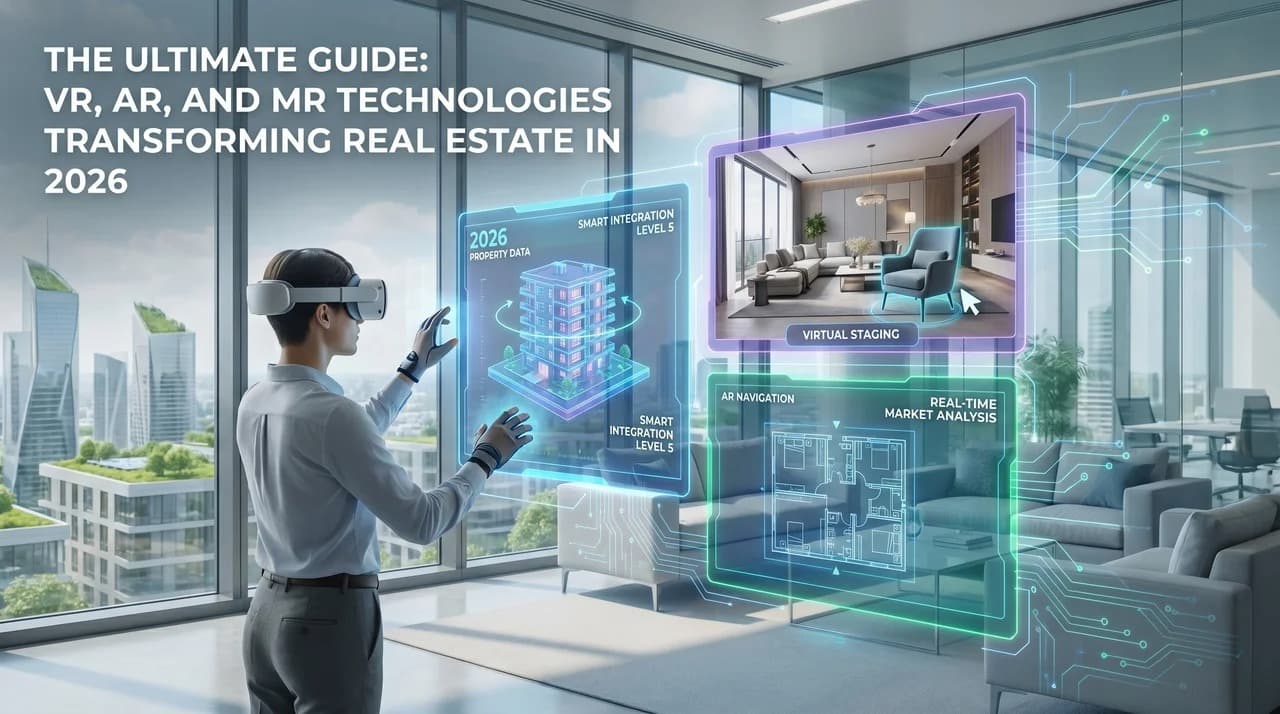
The real estate industry is changing faster than ever, especially with the rise of digital technology.
In the past, buyers relied on basic photos and 2D floor plans to choose a property. But today, that is no longer enough. Now, with virtual reality (VR), augmented reality (AR), and immersive real estate technology, people can explore properties in a completely new way. Instead of just looking at images, buyers can step inside virtual property tours and experience homes from anywhere in the world.
This shift toward immersive property experiences and metaverse real estate platforms is transforming how investors, developers, and buyers discover and invest in real estate.
If you are a property developer, agent, or investor, you are no longer just selling space; you are selling a digital property experience. Today, buyers expect more than images and brochures. Platforms like DaMeta1 Property Expo show how Virtual Reality (VR), Augmented Reality (AR), and Mixed Reality (MR), also known as extended reality (XR), are becoming essential in real estate. These technologies are no longer optional; they are now a key part of staying competitive in the global real estate market.
Understanding VR, AR, and MR in Real Estate
Before moving forward, it's important to understand the difference between VR, AR, and MR technologies. These terms are often used together, but each plays a unique role in improving the property-buying and investment experience.
Virtual Reality (VR)
Virtual Reality (VR) creates a fully digital environment. It allows buyers to take virtual property tours and walk through homes as if they were physically there. For example, a buyer sitting in London can explore a luxury apartment in Dubai in full 3D without traveling.
Augmented Reality (AR)
Augmented Reality (AR) adds digital elements to the real world. Using a smartphone or tablet, buyers can view a property and see virtual furniture, layouts, or building designs placed in real space. This helps them better understand how a property will look after completion.
Mixed Reality (MR)
Mixed Reality (MR) combines both real and virtual worlds. It allows users to interact with digital objects in real space. For example, a designer can place a virtual kitchen or furniture inside a room and walk around it to see how it fits and looks from different angles.
Comparison Table: XR Technologies in Real Estate 2026
| Technology | Core Function | Level of Immersion | Primary Real Estate Use Case |
|---|---|---|---|
| VR (Virtual Reality) | Replaces the environment | Full (Immersive) | Remote property tours, off-plan visualization |
| AR (Augmented Reality) | Overlays digital data | Minimal (Portable) | Virtual staging, mobile property info overlays |
| MR (Mixed Reality) | Merges/Interacts | Partial/Interactive | Real-time interior design, site modeling |
Why Investors and Developers Are Shifting to Immersive Real Estate
Today, more investors and developers are moving toward VR, AR, and metaverse real estate platforms because these technologies solve major problems in traditional property sales.
In the past, real estate was limited by location, high costs, and difficulty in visualizing unfinished projects. Now, with virtual property tours and immersive real estate technology, these challenges are quickly disappearing.
1. Global Property Access Without Limits
Traditional property expos are limited by time, location, and travel costs. But with platforms like DaMeta1 Property Expo, developers can showcase their projects to a global audience 24/7.
Investors from different countries can now explore the same property at the same time without traveling or attending physical expos. For example, a buyer in London, a developer in Dubai, and an investor in Singapore can all enter a virtual tour of a Manila high-rise condominium in Bonifacio Global City (BGC)—seeing the actual tower view, walking through the living room and bedrooms in 3D, checking floor plans, and evaluating rental potential in real time. At the same time, they could also explore a Bali luxury ocean-view villa in Uluwatu, where they experience the private pool, open living spaces, and cliffside sea views as if they were physically there.
All of this happens simultaneously, allowing global investors to compare properties, ask questions, and make decisions instantly—without flights, meetings, or geographical limits.
2. Stronger Buyer Connection Through Immersive Experiences
Buying property is not just a financial decision, but it's emotional too. Simple images and brochures often fail to create that connection. But virtual reality property tours allow buyers to step inside a home, explore every detail, and truly feel the space.
For example, a buyer can:
- Walk through a luxury lobby
- View interiors in 3D
- Experience the surroundings
This creates a stronger connection and helps buyers make faster decisions. With AI-guided virtual tours, the experience becomes even more powerful by showing properties based on the buyer's preferences.
Real-World Applications: How This Technology Is Used Today
These technologies are not just ideas; they are already being used in real estate.
Pre-Construction Property Visualization
With Mixed Reality (MR) in real estate, buyers can now explore buildings that are not yet constructed. They can walk through future apartments in a realistic virtual environment, change materials and layouts in real time, and clearly understand the full space before it is built. This advanced form of pre-construction property visualization removes confusion, reduces uncertainty, and significantly increases buyer confidence in off-plan property investments.
Virtual Staging with AR
Using Augmented Reality (AR) in real estate, empty properties can be transformed into fully furnished digital spaces. This modern virtual staging technology allows buyers to explore different interior styles, customize room layouts instantly, and visualize how their future home will actually look in real life. It creates a more engaging and realistic property experience, while also reducing staging costs for developers and improving overall property conversion rates.
Virtual Expo Booths & Digital Showrooms
Instead of investing in expensive physical exhibition spaces, developers are now using virtual real estate expo booths and digital showrooms. At platforms like DaMeta1 Expo, they can showcase their projects in full 3D, interact with global buyers in real time, and present property details while answering questions instantly. This creates a more interactive and engaging virtual property experience, builds strong trust between developers and investors, and makes it possible to complete global property deals without any physical presence.
The Path Forward: Moving Beyond the Hype
The adoption of VR, AR, and MR in real estate is no longer optional; it is becoming essential. These technologies improve the property buying experience by giving buyers clear, high-quality information early, reducing wasted time on unsuitable options, and speeding up decisions through transparency and trust.
As the industry moves toward a borderless, digital real estate economy, success will belong to those who fully adopt immersive property technology and metaverse real estate solutions as part of their core business.
Whether you are an architect or investor, these tools are already reshaping the future of property.
Explore the future with DaMeta1 Property Expo and experience the next era of global real estate innovation.