Why Virtual Exhibitions Are Disrupting the Global Property Market in 2026
Discover why virtual exhibitions have become the most disruptive force in the $873 billion global real estate industry and how DaMeta1 Property Expo connects developers with investors worldwide.
DaMeta1
Editorial
May 8, 2026
9 min read
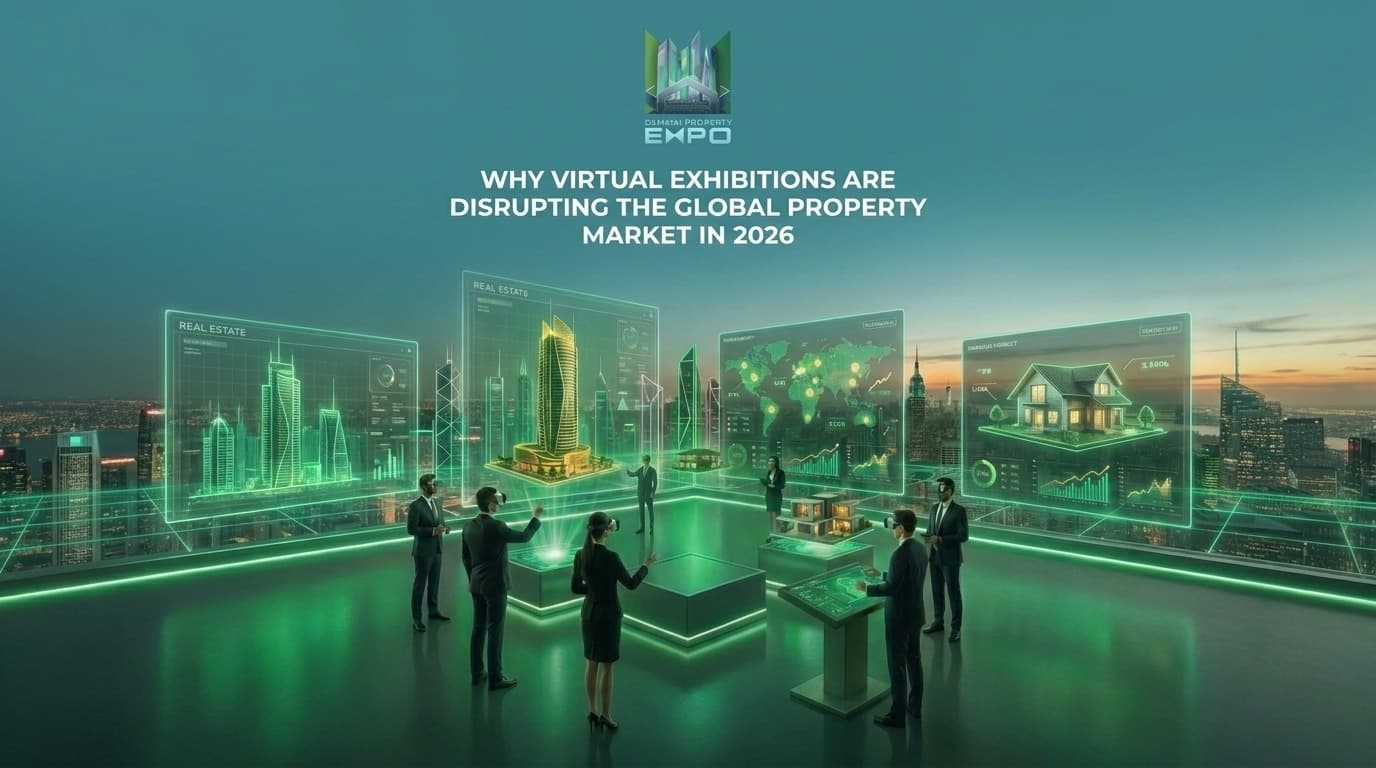
You Are One Decision Away From Reaching Every Investor on Earth. Most Developers Never Make It.
Right now, while you are reading this, a qualified investor in Singapore is searching for a luxury development in Dubai. A fund manager in London is evaluating off-plan opportunities in Southeast Asia. An OFW professional in Riyadh is ready to invest in a Philippine condominium. A high-net-worth buyer in Toronto is comparing branded residences across five global cities.
None of them is going to an expo in Cannes Film Festival next March. None of them is waiting for a four-day event in Dubai in November. They are online. They are ready. And they will invest with the developer whose property they can walk through right now, in full 3D, in real time, from wherever they are sitting.
If your development is not inside a virtual exhibition platform today, those investors are finding your competitor.
That is not a prediction about the future of real estate marketing. That is the documented reality of the global property market in May 2026. This blog gives you everything you need to understand why virtual exhibitions have become the single most disruptive force in the $873 billion global real estate industry and what the world's most forward-thinking developers and investors are doing about it right now.
The Global Property Market Is Bigger Than Any Single Expo Can Reach
Global direct real estate transaction volumes reached $216 billion in the first quarter of 2026 alone, rising 18% year-over-year. Cross-border investment was up 37% globally, reaching $55 billion in Q1 2026, the strongest first-quarter performance since 2022. Asia Pacific recorded 31% growth. The Americas rose 25%, as verified by JLL's Global Research Division.
Full-year 2025 global real estate deal value reached $873 billion, up 12% year-over-year, with capital concentrating on targeted opportunities across every continent.
That is not a market that fits inside one exhibition center in Cannes or Riyadh. That is a market that is actively transacting across every timezone, every continent, every quarter of the year. And the developers capturing the largest share of that cross-border capital are not the ones with the biggest exhibition booths. They are the ones with the most accessible, most immersive, most always-on global property presence.
What a Virtual Exhibition Actually Delivers vs What a Physical Expo Gives You
Here is the comparison every developer and investor should study before committing their next marketing budget.
| Factor | Physical Expo — MIPIM, Cityscape, EXPO REAL | DaMeta1 Property Expo Virtual Exhibition |
|---|---|---|
| Duration | 3–5 days per year | 365 days · 24 hours · every timezone |
| Audience size | Capped by venue and geography | 50,000+ active attendees · 1M+ ecosystem reach |
| Countries reached | Attendees from 90–100 countries in one city | Investors from 100+ countries simultaneously |
| Property experience | Brochures, renders, physical models | Full VR/AR/MR immersive 3D walkthrough |
| Multi-market discovery | Only exhibitors physically present | Walk 50 developments across 20 countries in one session |
| Operating hours | Event hours only | Any time — 2 am buyer in Singapore, 9 am investor in London |
| Lead qualification | Manual — post-event business card follow-up | AI-guided real-time investor matching |
| Transaction capability | Offline — weeks of legal process after the event | Blockchain-secured within the platform session |
| Cost to exhibit | $25,000–$107,000+ per event | Up to 33% lower than traditional expo cost |
| ROI compounding | Resets to zero after each event | Compounds daily — every new visitor, every day |
MIPIM 2026 — the world's largest real estate expo in Cannes — highlighted the continued strength of global real estate, with international investors representing nearly one-third of participants and institutions managing over €4 trillion in assets attending its RE-Invest Summit.
Impressive numbers. But here is the question every developer must ask: What happened to the other two-thirds of global qualified investors who were not in Cannes in March? Where did they discover their next investment opportunity?
They discovered it on a platform. They toured it virtually. They transacted digitally. And the developer who had no virtual exhibition presence missed them entirely.
5 Reasons Virtual Exhibitions Are Winning — With Fresh 2026 Proof
"I Just Want to Know Which Properties Are Worth My Time Before I Fly Anywhere."
This is the most common statement from high-intent global investors in 2026. They have capital. They do not have unlimited time. They will not fly to five countries based on a PDF and a render.
Research published just five days ago confirms that 90% of buyers now actively prioritize listings that offer immersive virtual tours, viewing this as a baseline for transparency and professionalism. Virtual tours reduce unnecessary physical viewings by up to 40% — because serious buyers self-qualify digitally first, ensuring that when they do visit physically, their intent is already high.
Virtual exhibitions solve this perfectly. An investor in Toronto tours ten developments across three continents in one afternoon session at the DaMeta1 Property Expo. They shortlisted three. They request a physical visit to one. That one visit closes.
The virtual exhibition is not replacing the physical transaction. It is making every physical interaction count.
"I Am a Developer. I Need Global Buyers — Not Just the Ones Who Happened to Be in the Same City as My Booth."
In 2026, over 67% of real estate listings globally will incorporate virtual tour features, according to data curated by Revenue Memo. Additionally, 72% of buyers prefer properties with virtual tours, while listings featuring them receive 49% more engagement and sell 31% faster, as outlined in the Revenue Memo Industry Insights. Properties with virtual tours also receive 87% more views than standard listings on major portals, a metric verified by case studies tracking data from Realtor.com.
The developers who understood this first did not wait for the industry to catch up. They built their virtual presence and let it compound.
DAMAC Properties achieved a $400 million sales increase and 400% higher engagement using immersive digital twins, as reported by Epic Games Unreal Engine and Economy Middle East. Advanced visualization technologies are driving 3–7% price premiums and faster sales cycles, while platforms like DaMeta1 Property Expo enable global, 24/7 virtual property showcases.
"I Want to Compare Properties in Multiple Countries Before Deciding Where to Put My Capital."
This is the use case that makes traditional expos structurally incapable of serving the modern global investor and the one that makes virtual exhibitions irreplaceable.
Traditional property expos are limited because people can only see projects available in one physical location. Events like MIPIM or Cityscape only showcase properties displayed at that venue, which means many global investment opportunities are missed. To reach a truly worldwide market, real estate exhibitions need to move beyond location-based limits.
On the DaMeta1 Property Expo, a buyer from Kuala Lumpur opens the platform and walks through:
- A luxury tower in Business Bay, Dubai
- An off-plan branded residence in Istanbul
- A Johor Bahru waterfront development targeting Singapore buyers
- A Bali villa community with 8% projected rental yields
- A Manila BGC condominium attracting OFW diaspora capital
All five. One session. Zero flights. Zero hotels. Zero visa stress.
According to the National Association of Realtors, 97% of home buyers used the internet in their home search in 2024, with many purchasing across states or even countries. VR and AR remove geographic barriers, making it possible to tour ten homes in an afternoon without ever stepping inside.
The investor who can evaluate five markets in one afternoon makes better decisions than the one who can only afford to visit one.
"I Have Capital Ready. I Need a Trustworthy Platform to Deploy It Globally."
The final high-intent user is the one with money looking for the right opportunity, not yet committed to a market, not yet committed to a developer, but actively seeking a platform they can trust with a serious investment decision.
For this user, three things matter above everything: breadth of verified opportunities, quality of property experience, and security of transaction.
The most expensive property sold entirely through a virtual transaction in the UAE in 2024 was valued at AED 35 million, proof that blockchain-secured, high-value cross-border real estate transactions are now fully operational inside digital environments.
Cross-border real estate investment reached $55 billion in Q1 2026, up 37% year-over-year, confirming that global investors are actively deploying capital across borders at unprecedented velocity.
DaMeta1 Property Expo is built specifically for this investor: a curated, immersive global property marketplace where every listed development is viewable in full VR, every investment opportunity is matched by AI to the investor's specific goals, and every transaction is secured on blockchain — from first viewing to signed documentation, inside one platform.
The Global Markets Virtual Exhibitions Now Serve Simultaneously
One of the most powerful features of virtual exhibitions is their ability to serve multiple global markets at the same time — something no physical expo has ever achieved.
| Region | 2026 Market Activity | Why Virtual Exhibition Wins |
|---|---|---|
| Middle East | UAE $144B · Saudi Arabia $73B · buyers from 113 nationalities | Global investors need digital-first access — they cannot all fly to Dubai |
| Asia Pacific | Q1 2026 investment up 31% YoY · Singapore records quarterly volume | Cross-border buyers in Singapore, Japan, and Australia demand immersive discovery |
| Southeast Asia | Malaysia $40B · Indonesia $70B · Philippines $94B | Off-plan dominant markets need VR; OFW diaspora investors are global |
| Americas | US + Canada up 25% Q1 2026 · 97% of buyers search online | 77M VR users in the USA alone — digital-first buyer expectation is universal |
| Europe | UK + Germany lead EMEA · Spain, Poland, Netherlands growing fast | MIPIM attendees represent a fraction of Europe's qualified investor base |
| Africa & Emerging Markets | Fastest-growing new investor class globally | First-time international investors cannot attend expos in Cannes or Munich |
The Platform That Connects All of It: DaMeta1 Property Expo
DaMeta1 Property Expo is the world's first and largest metaverse real estate expo — built specifically to solve every limitation that physical exhibitions cannot overcome.
For developers: Build one immersive 3D virtual booth. Reach investors from 100+ countries. Operate 365 days a year. Reduce exhibition overhead by up to 33%. Let AI match your development to the highest-intent buyers in real time.
For investors: Tour developments across every global market in one session. Use AI-guided recommendations calibrated to your budget, yield expectations, and property preferences. Conduct due diligence with blockchain-secured documentation. Transact — without leaving the platform.
For agents and brokers: Connect international buyers to global opportunities inside the same immersive environment where the buyer is already engaged. Close faster. Travel less. Serve more markets simultaneously.
For first-time global investors: Access the same quality of global property discovery previously available only to institutional buyers — without the travel budget, the agents in multiple countries, or the weeks of research.
The numbers: 50,000+ active attendees. 1 million+ ecosystem reach. 100+ countries. $40B+ PropTech market focus. 24 hours a day. 365 days a year.
Are You on the Right Side of This Disruption?
Over 67% of real estate listings globally now incorporate virtual tour features, according to real estate marketing benchmarks curated by Revenue Memo. Furthermore, consumer preference insights show that 82% of buyers consider virtual tours an important factor in their decision-making, and 47% of buyers are willing to make purchase decisions based solely on virtual tours, as documented by Realtor.com Case Studies. From an operations standpoint, time savings account for 66% of technology adoption by real estate professionals.
In 2026, when costs are rising and sales cycles are lengthening, efficiency is not a choice; it is a mandate. This digital shift directly aligns with a roaring capital market; the global property market generated $873 billion in deals last year, and cross-border investment jumped 37% in the first quarter of 2026 alone, as reported in the JLL Capital Markets Surge Analysis. The buyers driving that investment are online, immersed, and ready. They are walking virtual exhibitions right now.
The only question is whether they are walking yours.
Register for early access at dameta1expo.com, the world's first and largest metaverse real estate expo. Join 50,000+ attendees across 100+ countries. Connect with the global investors who are ready to move.
Your next international investor is already on the platform. Meet them there.